 dda
dda
Many established businesses are successful despite their systems, not because of them.
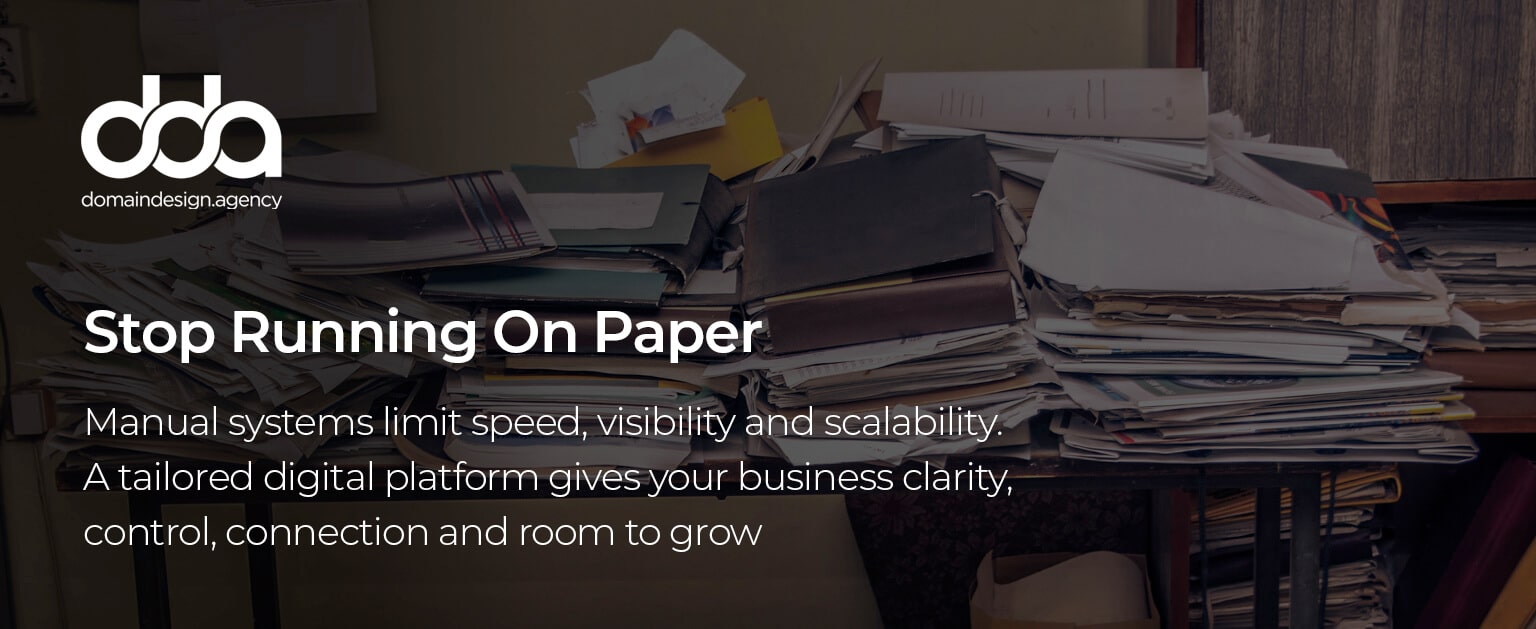
Across the UK, thousands of growing companies still rely on handwritten diaries, order books, paper job sheets, spreadsheets and memory to manage daily operations. It works, until it does not. The cracks appear quietly. Bookings overlap. Customer details are incomplete. Staff rely on verbal updates. Historical data becomes difficult to retrieve. Reporting becomes guesswork rather than insight.
The business itself may not be small, revenue may be strong, the team may be experienced, and the customer base may be loyal. But, if the operational structure is manual, disconnected or inconsistent, growth becomes harder than it needs to be.
The problem is rarely ambition. It is structure.
The Hidden Cost of Manual Systems
Consider a car garage taking bookings for MOTs, servicing and repairs. Every phone call requires asking for full contact details again. Staff search through previous job cards to understand vehicle history. Advisories from past visits are not immediately visible. Opportunities for preventative maintenance are missed because there is no centralised system highlighting patterns and the customers phoning in feel less cared for, with the same repeat questions every time they call.
Now imagine that same garage operating from a custom built digital management platform.
When a customer calls, their full record appears instantly. Past services, invoices, advisories and vehicle details are visible within seconds. Booking slots are clearly displayed. Follow up reminders are automated. Staff can confidently recommend additional work based on accurate historical data and have all the customers info to hand in seconds.
The difference is not convenience. It is control, speed and commercial intelligence.
The same scenario applies to many business types, take a flooring retailer with multiple locations. Without a centralised system, customer history may sit in a paper file in one branch. If a client calls another store or even the same store asking for the same carpet or flooring as before, time is wasted searching. If the original salesperson is not present, knowledge disappears and that is even if they can remember everything about every order!
With a unified digital system, every branch accesses the same information. Orders are recorded consistently. Product history is searchable. Customer communication is logged. Management can see performance across all sites in real time for all customers, orders and live bookings.
That is operational maturity.
Professional Services Are Not Immune
A solicitor firm may still track case notes across paper files, emails and individual memory. When a previous client calls about a related matter, valuable time is spent reconstructing history. Billing details, timelines and previous advice may not be immediately accessible.
With a structured system, client history, document records, communication logs and billing information sit in one controlled environment. Repeat instructions become easier to manage. Cross service opportunities become visible. Reporting becomes precise rather than estimated.
Or a recruitment agency faces similar friction when candidate data sits across spreadsheets and inboxes. If placement history, client preferences and candidate availability are not centralised, consultants lose speed and credibility. A tailored system connects client requirements, candidate pipelines and performance tracking into one coherent structure, with useful dashboards and to-do lists to hand.
This creates pressure, which creates rushed decisions. Strategy becomes secondary when your business relies on a host of manual paperwork.
Service Businesses And Trades
Construction companies often rely on job sheets, paper quotes and manual tracking of materials. As projects increase, so does complexity. Without a central platform, monitoring costs, timelines and subcontractor performance becomes reactive.
A structured system can track quotes, approvals, variations, materials, labour hours and invoicing. Leaders gain visibility across projects. Profit margins become measurable. Forecasting improves.
For electricians, plumbers or heating engineers, digital job management can record site visits, equipment installed, compliance documentation and recurring service schedules. Customer history becomes an asset rather than an afterthought, and you can even connect remotely on site to your system to update job sheets and maintenance forms on the job.
Healthcare And Appointment Based Businesses
Dental practices, physiotherapists and clinics depend on accurate appointment management and treatment history. Paper diaries and fragmented systems increase risk and inefficiency. Missed reminders reduce attendance. Incomplete records affect service quality.
A tailored digital platform centralises bookings, patient records, treatment notes and automated reminders. It improves both experience and operational control, and systems can be linked up to email or text alerts to allow your customers and clients easy access to important updates and messages.
From Busy To Structured
Many businesses reach a plateau where they are consistently busy but not efficiently structured. Growth increases pressure instead of clarity. More customers mean more paperwork. More staff mean more communication gaps. More revenue means more complexity.
At this stage, informal systems that once worked begin to restrict progress.
Knowledge sits in individuals rather than processes. If a key team member leaves, critical operational understanding leaves with them. Manual administration consumes time that could be spent on sales, customer relationships or strategic planning.
A custom built system captures how your business actually operates. It reflects your workflows, your terminology, your reporting needs and your commercial priorities. It creates consistency without removing flexibility.
This shift from informal to structured is often the difference between staying busy and building something scalable.
Data Creates Commercial Insight
When operations are digitised correctly, insight improves immediately.
• You can see repeat purchase patterns
• You can track seasonal demand fluctuations
• You can measure average order value accurately
• You can identify underperforming services or locations
• You can forecast workload based on real data
• You can save money with no paper or postage needs
Manual systems rarely provide this clarity. Digital infrastructure turns everyday activity into measurable intelligence to allow you to make better business decisions.
Designed Around Your Process
Off the shelf software can sometimes offer partial solutions. However, many businesses discover that generic platforms force them to adapt their processes to fit the software. This often creates friction and inefficiency.
A tailored system is different. It is designed around your business model. Your booking structure, your pricing format, your reporting requirements, your customer journey is all custom build bespoke to you.
Integration with marketing platforms, payment gateways, stock management systems and reporting tools can create a connected ecosystem rather than isolated tools.
The result is clarity.
• Clarity for staff
• Clarity for management
• Clarity for your customers
• Clarity for growth
Operational Infrastructure Is A Competitive Advantage
In competitive markets, businesses often focus heavily on promotion. More advertising, more campaigns with short term tactics.
Visibility matters. But operational infrastructure determines how effectively growth is handled long-term.
If enquiries increase but systems cannot cope, service quality declines. If bookings rise but reporting is weak, leadership cannot make the right decisions. If customer history is fragmented, opportunities for repeat business are lost.
Strong systems turn activity into structured revenue. They reduce administrative waste, protect data, improve customer experience, while increasing valuation and sales.
Businesses with documented processes and integrated digital systems are more attractive to investors, partners and potential buyers. Structure signals stability, and stability signals professionalism.
Preparing For The Next Stage
Every business owner eventually faces a decision point. Continue operating in a familiar way that feels manageable but increasingly stretched and disjointed. Or invest in structure that supports the business growth.
Replacing paperwork with a custom built management system is not about technology for its own sake. It is about reducing friction, improving insight and strengthening foundations.
Marketing generates enquiries, branding shapes perception, and visibility drives demand, and your structure sustains it.
Your business is not small.
If managing it feels harder than it should, the issue may not be demand or competition. It may be that your systems have not evolved at the same pace as your ambition.
The businesses that scale successfully in 2026 and beyond will not only perform better, they will operate with clarity, control and confidence.
Structure is no longer optional. It is the platform on which sustainable growth is built for all business types in all sectors.

Our Design and Web Marketing Agency delivers far more than visibility. We design and develop tailored business systems that streamline operations, centralise data and support long term growth. Explore our services to discover how we combine structure, strategy and measurable performance to help ambitious businesses operate with clarity and scale with confidence Web Design Services, Ecommerce Online Shop Development, SEO Marketing For Your Business, Google PPC Per Click Campaign Management, and our Graphic Design Services provided nationwide to our UK clients from our Glasgow base..